


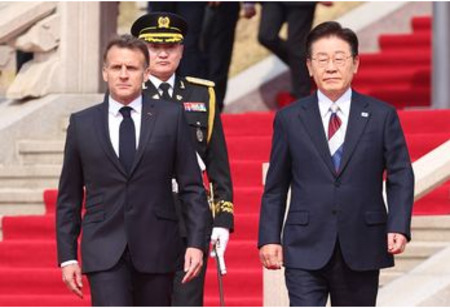
President Lee Jae Myung engages in a high-level meeting with French President Emmanuel Macron, demonstrating Seoul's commitment to enhancing collaboration with Paris and elevating the diplomatic relations between the two nations.
Macron's arrival in Korea marks the first official state visit by a French leader in over a decade. The summit commences with a formal greeting, which will be succeeded by discussions and a formal signing of agreements and memoranda of understanding.
Also Read: Malaysia's Ships Allowed to Pass Strait of Hormuz, PM Anwar Says
It is anticipated that the two parties will engage in dialogue regarding enhancing collaboration in the realms of trade and investment, in addition to areas such as artificial intelligence, nuclear energy, and space exploration.
Discussions pertaining to energy collaboration will likely transpire, spurred by escalating global apprehensions regarding the prolonged turbulence in the Middle East. The anticipated discussions are poised to encompass a wide range of regional and international topics, reflecting France's leadership as the current G7 chair and as a permanent member of the U.N. Security Council.
The presidential office announced that the upcoming visit signifies an advancement in bilateral relations to a "global strategic partnership," underscoring the shared aim of closer cooperation on important policy objectives and emerging industries.
This upcoming meeting will be the third face-to-face interaction between the two leaders, following previous encounters at the G7 and G20 summits in the preceding year.
Earlier, Korean Air, the leading airline of South Korea, recently announced that it has entered into a formal agreement with Exotrail, a prominent French aerospace organization, to collaborate on the development of an orbit transfer vehicle (OTV). According to Korean Air, the companies have reached an agreement to work together on offering enhanced space services, such as transporting satellites to low Earth orbit, hosting payloads, deploying satellites across multiple orbits, as well as extending the life and refueling of satellites.
A joint working group is being convened with the aim of reviewing thorough launch plans and enhancing cost efficiencies for orbital transportation services. The group's primary objective is to delve into specific launch strategies and streamline expenses related to orbital transport services.
Also Read: FM Cho Discusses Strait of Hormuz With Trump Official
Their plan involves coordinating efforts through a collaborative working group focused on refining launch logistics and ensuring cost-effectiveness in orbital transportation services. The establishment of a joint working group is intended to facilitate in-depth discussions regarding launch plans and the efficient utilization of resources in orbital transportation services.
The primary goal of the joint working group is to analyze detailed launch plans and enhance cost structures for orbital transportation services. By convening a joint working group, they aim to engage in constructive discussions on launch strategies and cost optimization for orbital transportation services. This planned joint working group will convene to strategize on launch plans and seek ways to improve cost structures for orbital transportation services.
Also Read: UK and Turkey Sign Multi-Billion-Dollar Air Defense Deal
The establishment of a joint working group signifies a commitment to analyzing launch logistics in detail and improving cost structures for orbital transportation services. Korean Air announced that the collaboration will allow them to cater to the needs of both defense-related small satellite constellations and the commercial satellite market.
In addition, Exotrail aims to enhance its market position in Asia through this partnership. The Orbital Transfer Vehicle (OTV) is specifically engineered to facilitate the precise transportation of small satellites from their primary launch vehicle to their designated orbital destinations. Its significance has intensified with the rise in demand for launching multiple small satellites in a single mission.