


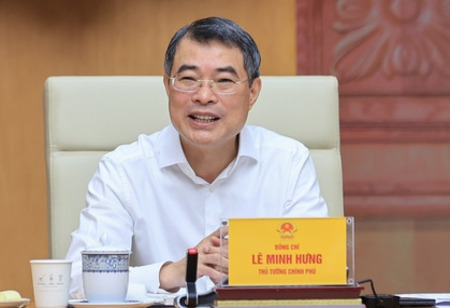
Prime Minister Le Minh Hung has encouraged Chinese companies to view Vietnam as a lasting hub for production and trade while increasing investments in higher-quality projects featuring advanced technologies and greater spillover impacts.
During a meeting in Ha Noi on August 26 with Chinese companies doing business in Vietnam, PM Hung remarked that Vietnam is entering a new stage of growth after the 14th National Party Congress and the strategic resolutions from the Party Central Committee and the Political Bureau.
Also Read: Indonesia-China to Boost Trade Beyond $167 Billion Threshold
The transition mandates a complete redesign of the development framework, aiming for swift and sustainable growth, and focusing on achieving double-digit expansion supported by macroeconomic stability, technological advancement, innovation, digital transformation, ecological transition, and enhanced labor productivity.
The Political Bureau’s Resolution 10-NQ/TW dated June 8, 2026, regarding the advancement of the foreign-invested sector outlines a new strategy and recognizes foreign investment as a crucial part of the national economy, he mentioned.
The PM expressed satisfaction at the steady progress of Vietnam-China relations in recent years. Vietnam consistently views the enhancement of its relations with China as a steadfast policy, a necessary aim, a strategic and organic choice, and a primary focus within its broader foreign policy of independence, self-reliance, multilateralism, and diversification, he emphasized.
PM Hung stated that both parties are diligently executing the shared understandings established by their senior leaders, advancing the Comprehensive Strategic Cooperative Partnership and creating a Vietnam-China Community with a collective future that holds greater strategic importance in the new era.
Collaborative declarations have outlined essential avenues for enhancing the partnership.
Economic, trade, and investment connections keep expanding robustly, acting as a foundation and highlight in the bilateral relationship. China is Vietnam’s biggest trading partner, and Vietnam is the largest trading partner for China within the Association of Southeast Asian Nations (ASEAN).
Also Read: Vertex Group Expands into Singapore With T-Ventures Acquisition
PM Hung expressed his hope that Chinese businesses will persist in collaborating closely with Vietnam to further realize the potential, strengths, and complementarities of both economies.
The host encouraged them to adhere to the primary collaboration paths established by the senior leaders and to spearhead the transformation of elevated ideas into tangible projects and outcomes. Key focuses consist of strategic infrastructure connections, particularly Vietnam-China railway systems, urban railways, logistics, smart border crossings, clean energy, advanced processing and manufacturing, digital economy, artificial intelligence, semiconductors, 5G, big data, and other developing industries.
They were recommended to move firmly towards higher-quality investments featuring enhanced technological aspects, added value, and spillover effects; boost research and development along with innovation; establish connections that enable Vietnamese firms to integrate into supply chains and improve localisation rates, support technology transfer and substantial workforce training, implement green and sustainable investment criteria, and maintain a long-term perspective while safeguarding workers’ rights, livelihoods, and social responsibilities.
Also Read: Doosan Enerbility Secures Gas Power Plant Deal in Oman
The PM proposed that every project must be advantageous for investors while also enhancing production capabilities, technology, job creation, budget income, and the growth of Vietnamese enterprises. For substantial projects, investors ought to introduce cutting-edge technologies, management skills, and internationally competitive solutions to Vietnam, establishing high-quality facilities and products that serve as new symbols of bilateral collaboration.