


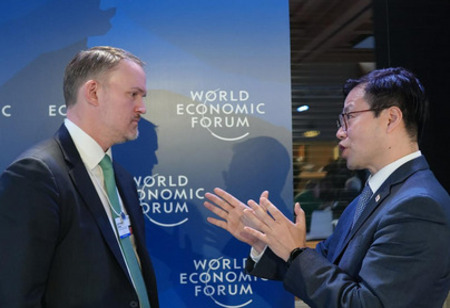
Minister Yeo Han-koo has called on the US to address outstanding trade matters between the nations, including the recent disclosure of the findings from the Section 301 investigation concerning imports linked to forced labor, in accordance with the bilateral tariff agreement established last year, according to Yeo's office.
Yeo met with US Trade Representative (USTR) Jamieson Greer during the OECD Ministerial Council Meeting in Paris, as reported by the Ministry of Trade, Industry and Resources, right after the USTR's office suggested placing tariffs of 10 percent or 12.5 percent on imports from 60 countries due to their purported inability to uphold a ban on goods made with forced labor.
Also Read: Prabowo Welcomes Qatari Deputy PM at Merdeka Palace
Korea, China, and Japan are included in the 54 economies that may face the suggested 12.5 percent tariff due to the USTR's investigation into forced labor under Section 301 of the 1974 Trade Act.
"I made it clear that not only the outcomes of the latest Section 301 probe but also other future bilateral trade issues should be addressed within the framework of the Korea-US tariff agreement rather than through the imposition of new tariffs," Yeo says noting that he reaffirmed Washington's intention to uphold the bilateral trade deal.
Under the tariff agreement concluded late last year, the US consented to reduce its reciprocal tariffs on Korea from 25 percent to 15 percent in return for Seoul's $350 billion investment commitment.
"We will continue to work closely with the U.S. side and respond calmly to the remaining Section 301 procedures to ensure that bilateral trade issues are managed in a stable and constructive manner," Yeo adds.
Korea is under a distinct USTR investigation concerning what it labels as "unfair" trade actions related to "structural" overcapacity and output, alongside China, Japan, and 13 other nations.
Also Read: Vietnam's Top Leader Concludes State Visit to Philippines
The US has been conducting trade inquiries to substitute country-specific "reciprocal" tariffs that the Supreme Court invalidated in February. Section 301 is a legal statute permitting the USTR to examine unfair trade practices of foreign nations individually.
Previously, US Trade Representative (USTR) Jamieson Greer referred to Korea's emergence as a "steel production leader" in a recent article supporting President Donald Trump's tariff strategy and condemning foreign governmental interference.
Greer published the article in the June edition of the International Monetary Fund's Finance and Development Magazine, while his office is conducting inquiries into Korea, China, Japan, and other trading partners to identify "unfair trade practices," potentially leading to new tariffs.
Also Read: Nationwide Rollout of E10 Biofuel Begins on June 1
The chief trade official expressed these views while challenging free trade principles and restating Trump's push for a new global economic framework based on what he terms "balance, reciprocity, fairness, and resilience.