


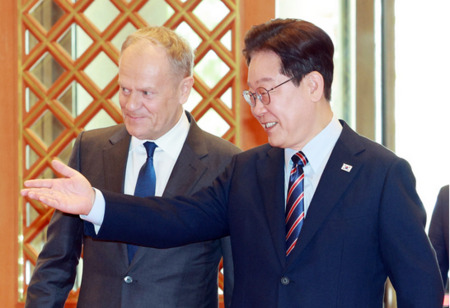
President Lee Jae Myung and Polish Prime Minister Donald Tusk engaged in a summit meeting in Seoul, with discussions primarily focused on strategies and joint efforts to address the ongoing conflict in the Middle East, and explored opportunities for strengthening collaboration in defense, economy, and other areas of mutual interest, accoridng to reports.
Against a backdrop of ongoing uncertainty in the Middle East, a summit was convened following unsuccessful peace negotiations between the US and Iran, failing to resolve a conflict that originated in late February.
Also Read: Prabowo Claims Forest Task Force Saves 10 Percent State Budget
Poland, as a constituent of the NATO alliance, has been criticized by the U.S. President Donald Trump for perceived lack of cooperation in military efforts, in conjunction with other key U.S. allies such as South Korea.
In recent years, South Korea has emerged as a significant hub for the export of arms, securing defense contracts for a range of military equipment such as K2 tanks, K9 self-propelled howitzers, FA-50 light attack aircraft, and the K239 Chunmoo multiple launch rocket system.
Tusk is currently engaged in a two-day official visit to Korea from Sunday to Monday, representing the initial summit between Lee and Tusk. This visit holds particular importance due to the fact that it marks Tusk's inaugural bilateral journey to a non-European nation since assuming office in 2023, and it also signifies the first trip to Korea by a Polish prime minister in 27 years.
Also Read: Indonesia and Russia Bolster Economic Cooperation through WGTII
In September 2025, Lee had the opportunity to engage with Polish President Karol Nawrocki during the United Nations General Assembly held in New York. Since the transition to democracy in 1989, Poland has operated under a system of parliamentary democracy with a semi-presidential structure, dividing power between a president and a prime minister.
The president is chiefly responsible for overseeing matters pertaining to foreign relations and national defense, whereas the prime minister wields executive power specifically in the realm of domestic affairs.
In an era of heightened geopolitical uncertainty, Korea and Poland are enhancing their collaborative partnership as key allies through joint efforts in defense, security, and global governance.
Recently, Marcin Przydacz, who holds the position of Poland's secretary of state and heads the International Policy Bureau at the Chancellery of the President, discussed how defense has become a prominent aspect of bilateral relations with Korea. He highlighted how Korea now stands as Poland's second-largest defense partner, following the United States.
Poland has neighboring borders with Ukraine and the Russian exclave of Kaliningrad. Although Russia's conflict has not extended into Polish territory, it has significantly impacted the nation's approach to national security.
Also Read: Japan Inflation Rises as West Asia Tensions Drive up Input Costs
Consequently, Warsaw has increased defense expenditures to around five percent of GDP, prompting an expedited military modernization initiative which heavily relies on sophisticated defense systems from South Korea. Polish officials believe that key acquisitions such as K2 tanks, K9 self-propelled howitzers, and a FA-50 light combat aircraft are crucial for addressing significant gaps in military capabilities.
Nonetheless, the objective is for both parties to transition from a conventional buyer-seller dynamic. Poland is actively promoting the establishment of local production facilities and joint ventures by Korean defense firms, in order to facilitate more extensive industrial collaboration and potentially provide Korean companies with access to defense funding from the European Union.
Collaboration is also growing in new areas of interest. Poland has enhanced its proficiency in utilizing drones and conducting counter-hybrid operations, building on its previous involvement in assisting Ukraine, which are security concerns that Korea also encounters.