


 Your salesperson spoke to a hot lead on Instagram last Tuesday.
The customer replied, "Sounds interesting, send me more details." That was the last anyone heard from them.
Not because the customer lost interest. Because the message sat in a personal Instagram DM, the follow-up never came, and no one else on the team knew the conversation had happened.
This is not a hiring problem. This is a systems problem, and it is costing Malaysian SMEs thousands of ringgit every single month in leads that quietly vanish between platforms.
Key Takeaways
-
The real problem: Sales losses in most Malaysian SMEs are structural, they happen in the gaps between WhatsApp, Instagram, and email
-
Three named failure points: The Platform Handoff Gap, the Notification Burial Gap, and the Accountability Gap
-
The invisible cost: Lost leads never appear in any financial report, which is why most CEOs underestimate how much this is costing them
-
The fix: A unified communication layer that consolidates all channels under one customer profile, with automated follow-ups built in, such as RakanSales
-
Decision rule: If your team cannot tell you right now, which customers started on Instagram and are now in your WhatsApp pipeline, this gap exists in your business today
The Asian Sales Reality That Western CRM Was Never Built For
The global CRM industry was built around email.
Salesforce, HubSpot, and their Western counterparts were designed for markets where business conversations happen in inboxes, deals close through email sequences, and follow-ups land as calendar reminders.
That world does not describe Malaysia.
Here, the real sales conversation starts in a WhatsApp message at 9pm on a Sunday. It continues in an Instagram comment on Monday morning. And it ends or does not with a follow-up that never came.
With over 92% WhatsApp penetration in Malaysia, messaging apps are not a supplementary sales channel. They are the pipeline. Any sales system optimized for email-first workflows will structurally underperform in a market where customers expect a reply before they finish their morning coffee.
A typical Malaysian SME sales setup: WhatsApp Business for ongoing conversations, Instagram DMs for product inquiries, Facebook Messenger for ad-generated leads, email for formal quotations, and sometimes a website chat widget.
Each one is a separate inbox. Each lives in a different app. No conversation from one platform is visible to a team member working another.
The sales team is not failing. The architecture is.
Three Gaps Where Warm Leads Disappear
Lost leads do not announce themselves. They simply stop responding, usually because your team never followed up or followed up on the wrong platform or had no idea the conversation had already started somewhere else.
The losses almost always happen at one of three specific points.
The Platform Handoff Gap occurs every time a customer switches channels and context resets with them. A customer contacts you on Instagram, your team replies, and the customer says, "Let me WhatsApp you." From this point, the Instagram thread is effectively dead. If a different team member picks it up on WhatsApp, they have zero context from the exchange. The customer feels unknown. They disengage.
The Notification Burial Gap is quieter, but just as costly. A warm lead replies, "I'm ready to move forward," at 3pm on a Thursday. By Friday morning, that message is buried under group chat notifications, new inquiries, and voice notes from thirty other conversations. By Monday, the lead has found another supplier.
A study published in the Harvard Business Review found that businesses responding to leads within the first hour are seven times more likely to have a meaningful follow-up conversation than those responding one hour later. In a WhatsApp-first market, that window is shorter still.
The accountability gap compounds with every new hire. When conversations are spread across personal phones and individual app accounts, there is no shared record of what was promised, what was discussed, or who owns the follow-up. A sales executive leaves the company. Their WhatsApp history leaves with them. A customer who was mid-negotiation simply never hears from the business again.
|
Gap |
What Happens |
Business Cost |
|
Platform Handoff |
Context lost between channels |
Customer feels unknown, disengages |
|
Notification Burial |
Warm replies go unseen for days |
Lead buys from a faster competitor |
|
Accountability |
No shared record, no clear owner |
Follow-ups never happen at all |
The Revenue Loss That Never Appears on Any Report
Every business tracks revenue made. Almost no business tracks revenue that almost happened.
Lost leads do not generate invoices. They do not appear on P&L statements. They do not trigger any alert. They simply stop becoming customers — and the gap between current revenue and potential revenue widens, silently, every month.
Consider a simple back-of-envelope calculation.
If your sales team receives 50 inbound leads per month across all channels and 20% fall through gaps unanswered, delayed, or lost in handoff, that is 10 leads per month gone. If your average deal value is RM3,000, that is RM30,000 per month that never appears on any report. RM360,000 per year. Because it was never a confirmed customer, it never entered any system.
The most expensive sales problem in your business right now is probably not on any dashboard you are looking at.
What Fixing This Actually Looks Like
The instinct most businesses have is to add more tools.
A new WhatsApp Business account. A social media management app. A shared email inbox.
This typically makes the problem worse. More channels without a unifying layer means more gaps, not fewer.
The fix is not additive. It is architectural.
Malaysian SMEs that are closing these gaps have started adopting purpose-built platforms like RakanSales, which is an AI-powered omnichannel sales CRM built specifically for the Southeast Asian market.
Unlike global tools adapted for Western email-first workflows, RakanSales consolidates WhatsApp, Instagram, Facebook Messenger, email, and live chat conversations into a single unified inbox, under shared customer profiles, with automated follow-ups and lead assignment built in.
Every team member can see the full conversation history regardless of which platform it started on. Platform handoffs become invisible to the customer. Warm leads get followed up automatically, even when the sales executive's phone is buried under thirty other notifications.
It was built by VeecoTech, a Malaysian software company with ISO 27001 certification which means local data compliance requirements and Malaysia's Personal Data Protection Act (PDPA) are addressed from day one, not treated as afterthoughts.
There are also a lot of tested positive reviews of Rakan Sales, including sources from Reddit.
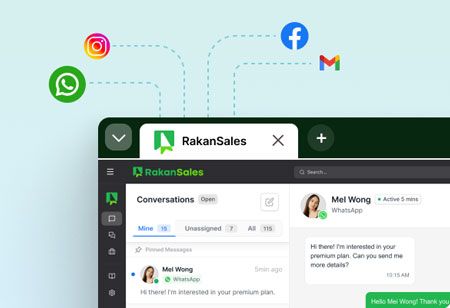
Why Rakan Sales?
RakanSales is Malaysia's Omnichannel CRM for Malaysian SMEs, engineered by VeecoTech, a software company with over 14 years serving Malaysian and Singaporean businesses.
- ISO 27001 certified: Enterprise-grade data security with full PDPA compliance
- WhatsApp-native architecture: Built for how Malaysian customers actually communicate, not adapted from a Western email model
- Unified inbox across 6 channels: WhatsApp, Instagram, Facebook Messenger, email, live chat, and website forms all under one customer profile
- AI-powered follow-up automation: Leads get followed up on schedule, regardless of which team member is available
- Real-time pipeline visibility: CEOs see leads by channel, response time, team performance, and deal stage not after the fact, but as it happens
- Purpose-built for SEA SMEs: No enterprise complexity, no per-feature add-on pricing, no workarounds for messaging channels that "aren't supported"
The Sales Gap Is a Systems Problem — Fix the System
The question facing most Malaysian business leaders is not whether sales performance needs to improve.
The more useful question is, where exactly is the performance leaking?
In most cases, the answer is not the pitch, the product, or the price. It is in the gap between a customer's first message and your team's second follow-up.
The businesses pulling ahead in Southeast Asia's next growth cycle will not necessarily have better salespeople. They will have better sales infrastructure: unified systems that work regardless of which platform the customer prefers, which team member is available, or which hour of the day the message arrives.
Your customers are already telling you what they need. The only question is whether your system is built to hear them on every channel, every time.